Wow.
What a drama that was, and how unwarranted it was, too. As I'm painfully aware, there are still plenty of people who will waste no time in extolling the horrors of matchmaking and just what a low and depraved group of individuals comprise Infinity Ward; no doubt they do this despite begrudgingly playing (and probably enjoying) the game. MW2 created such an uproar that despite being literally half the world away from my own PC, I figured it pertinent to look back on the entire fiasco and share my thoughts here. I've also got little else to do for the next few hours, so naturally, typing this will amuse me enough to kill some of that time.
Right from the outset, my predicament varies drastically from that of many MW2 owners; I had the game pre-loaded, all ready to go, but I couldn't play it. It wasn't until four weeks after its release - nearly five, in fact - that I finally got to fire up the game which has caused one of the biggest online shitfights I can recall. Communities fractured, friends became arch enemies... it was absolutely ridiculous, and in the end, it was also absolutely pointless. While I have no doubt at all that various people will disagree with me, I thought MW2's multiplayer a drastic improvement over the ever-frustrating experience of the original Modern Warfare. The touted lag was nowehere to be seen; in fact, I ran into no more trouble with it than I have in any of the locally-based dedicated servers I frequent. Yes, occasionally the game has to pause for a minute or two while it migrates hosts, and yes, that has resulted in my painful and very avoidable death on multiple occasions. So what? It's a minor annoyance. It happens maybe once every five games for me, and that's at most - some days it won't happen at all. One unfair death or missed kill a day is hardly justification for the mess that followed the big announcement.
One of the other major concerns was the tactical nuke; again, this was something I found to be a non-issue. If one person can seriously get that many kills in a row without dying, it's a pretty sure sign to me that there's a severe skill stack going on, and most of the time that results in the game being little to no fun at all for those of us who still whoop with glee when we get killstreaks of more than five. An early ending to a game is hardly a life-ruining experience, and if it keeps happening, there's nothing stopping you from dropping out to find another match. I guess we're all just so used to being spoon-fed by developers that today's gamers will suffer a severe mental breakdown at the thought of actually needing to act on their own behalf.
Another concern - the customisable killstreaks. Again, non-issue. Don't like getting hammered by that C-130? Then find some cover and stay there, like any sensible being equipped with a survival instinct would do. I don't see how the new killstreaks are any worse than MW's helicopters or airstrikes were - in fact, a number of them are significantly less destructive and in the case of the care package, even useful to the other team if captured. Truth be told, the two killstreaks which proved most disruptive were - and brace for a shock here - the air strike and the helicopter. Amazing.
After several days solid of enjoyable play in various gametypes using matchmaking, I can honestly say that I'm glad Infinity Ward dared to rattle the cage of the PC gaming community. I'd even go so far as to say I'm glad that they went on to thrust a gigantic middle finger at those who couldn't accept this change.
Sunday, January 3, 2010


Saturday, December 19, 2009
Epiphany
I can't believe it took me this long to work it out, but I've finally cracked the mystery of why ArmA 2's terrain, while being nearly photorealistic, feels unnatural.
There's no dead ground.
I'm not talking about huge valleys or sprawling basins, because as we all know, there's no shortage of those. No, what I'm talking about is the smaller-scale stuff - the stuff yours truly would seek refuge in with his mates in a contact. Drainage canals, creekbeds, culverts along the sides of the road, berms, craters, fissures, erosion channels... the list goes on. Nowhere in the entire game world - and now I think about it, nowhere in that of the first game, either - do I recall seeing any of these. Considering that ArmA 2 is regarded a sim rather than a shooter, and also considering the heavy emphasis on infantry combat, wouldn't you think that the infanteer's favourite forms of cover would be included from the outset?
I'd gladly sacrifice a few forests, truck-sized boulders, and locked buildings to see these included in ArmA 2. Don't even start me on the gates and doors, though.
There's no dead ground.
I'm not talking about huge valleys or sprawling basins, because as we all know, there's no shortage of those. No, what I'm talking about is the smaller-scale stuff - the stuff yours truly would seek refuge in with his mates in a contact. Drainage canals, creekbeds, culverts along the sides of the road, berms, craters, fissures, erosion channels... the list goes on. Nowhere in the entire game world - and now I think about it, nowhere in that of the first game, either - do I recall seeing any of these. Considering that ArmA 2 is regarded a sim rather than a shooter, and also considering the heavy emphasis on infantry combat, wouldn't you think that the infanteer's favourite forms of cover would be included from the outset?
I'd gladly sacrifice a few forests, truck-sized boulders, and locked buildings to see these included in ArmA 2. Don't even start me on the gates and doors, though.
Tuesday, November 10, 2009
Borderlands
Over the past few days, I've been gaming hard. I'm leaving very shortly to go to basic training, where I will remain for four weeks (or so I hope); few things bother me more than to leave a story unfinished, so I was intent on completing Borderlands before my departure.
At first, I wasn't sure what to think. The effort put into the game's intro sequence alone was pretty impressive; however once I embarked upon my journey, it began to feel a lot like I imagine Fallout 3 would have if Bethesda had left out a lot of the extraneous bullshit. Don't get me wrong, I like the sheer amount of features in that game; VATS makes up for the awful manual aiming (although I would rather they fixed that instead), and I wasted no time in setting about rescuing every teddy I could find from the horrors of the Capital Wasteland. The ability to just mess about doing things like this was kind of entertaining, but at the same time it diverted me away from the main story time and time again; I'd take on one side mission and end up trying to complete ten all at once. While Borderlands presented me with a lot of the same issues - particularly the one where I would have a small nervous breakdown trying to work out which areas to explore, for fear of forgetting to look somewhere else - it did it a lot less often and the side quests were generally fairly short, which was nice.
The game started out at a rather leisurely pace; in fact, it remained that way for most of its duration, again echoing the things about Fallout 3 which irritated me. Forgive me for comparing the two almost exclusively, but it's for reasons of simplicity, not a belief that Borderlands is any attempt at a copy of that game. Fallout 3 is the most recent game I've played which I can really compare Borderlands to at all. To get back on track, the reasons for this were twofold: slow-paced missions, or plenty of missions. As the game progressed, the number of quests available skyrocketed and it took me about two days to get through the New Haven phase of the game alone. That said, I was enjoying myself. While a lot of the side objectives tended to repeat themselves - searching for objects scattered either locally or over an entire map segment being the worst offenders, followed by elimination challenges - they usually coincided fairly nicely with my more important tasks or even each other, allowing me to wrap up anything from two to six all at once. I'm not entirely sure how, but Gearbox have somehow managed to stop this from boring me to death, like it would in most games. Gearbox have also managed to reference a variety of absolutely brilliant movies without making things seem cheesy, and I got a good laugh out of spotting these. At times things became a little tedious, but never enough for me to quit the game for days, weeks or months on end like I generally do; I took breaks every few hours, but then I was right back into the game.
I think that the sheer uniqueness of the game's art style played a large part in appealing to me. It's something I haven't seen for a long time, and it's always nice when a dev decides to fly completely in the face of the current trends, even when there's no real guarantee that the gamble will pay off. Originally, Borderlands subscribed to the same gritty over-realistic, Hollywood-esque style that many recent titles have used; although it still featured far more colour than most of those games, there wasn't much else to distinguish it visually. In changing to a completely unrealistic, almost cartoony art style, Gearbox not only managed to make it stand out from the crowd, but they also proved that you don't have to follow everyone else's lead to produce a popular game. Even in the absence of the usual long cinematic sequences or rooted-to-the-spot exposition dialogues, I found it relatively easy to lose myself in the world of Pandora; I developed an almost parental over-protectiveness of Claptraps, and took great glee in mowing down any who I found near a hurt one. I developed something of a 'feel' for the characters' personalities, usually spotting a betrayal or a helping gesture before it came. Most importantly, I felt the kind of drive to reach the Vault while keeping Lilith as safe as possible that I needed to finish the game (despite there being no real penalty for dying). Even though no real backstory was provided for the characters ingame and scant details were all I had seen elsewhere, it was fairly easy to work out what made Lilith (who is an absolute force to be reckoned with in good hands) tick. That said, I would've liked the chance to actually learn more about each character at some point in the game; like L4D, vague details and subjective guesswork are all that are available.
Returning to the gameplay itself, once again, the Fallout 3 comparison rears its ugly, desolate head. Both games featured a slow lead-up to a tipping point after which no amount of willing the game to slow down would help. That's it, really; the story just hit its climax and ran away wildly, like a kid tyre-rolling down a hill. In the case of Fallout 3, I actually went back and loaded an earlier save before buggering off and setting out to explore the remaining two-thirds of the game world, abandoning the final quest as it neared its close. I genuinely hadn't expected things to take off so fast, and as I'd finished the game, I knew how I would end it. To this day, Fallout 3 appears confused as to whether I've finished the main quest or not, evidenced by the mixed news updates on GNR. This is essentially the same problem I had with Borderlands; I had a few side quests I was partway through, and whole areas of the game world I had only given a cursory glance to. In particular, the latter areas of the game were all but unexplored to me, as I'd been so single-mindedly intent on reaching the Vault. I'm trying to keep this relatively spoiler-free, so I won't go into specifics; however, Thor was the tipping point, and from there on I didn't stop for hell nor high water. I did stop for hurt Claptraps, but I digress.
Once the inevitable had happened, and I had finished the game - the ending of which, by the way, felt like a bit of a slap in the face - I sat and watched the credits roll, and began the inevitable comedown that follows a long binge on a game which has managed to really draw me in. You can imagine my surprise, then, when the credits stopped rolling and I found myself standing alone in the snow, a single objective marked on my HUD.
Borderlands isn't quite done with me yet, and in a way, I'm kind of glad. While the actual main story was incredibly short and wonkily paced, much like Fallout 3's, I wasn't ready to just leave Pandora, or Lilith, to gather proverbial dust. In conclusion - because I have to end this barely-coherent mess of thoughts somewhere - Borderlands is something like a donut to me: thoroughly enjoyable, but leaving you wanting more. Gearbox is already working on DLC which will add new areas, enemies, and quests, but in this gamer's mind, a more filled-out main story would be worth more than all the DLC in the world. Borderlands will probably suffer somewhat upon my return as I'll no doubt binge on MW2 and L4D2, but it can certainly rest assured that I won't be able to leave it alone for any longer than necessary.
Like a hurt Claptrap, really.
Edit - and this does contain something of a spoiler - I should probably make one final note, which is that my disappointment with regards to the ending was due to the speed at which it arrived, not what it entailed. A lot of people seem upset that they couldn't do what they expected to do; well, you can't always get what you want. If anything, it's nice to see a game which leaves the player feeling well and truly stitched up and wondering if anything they'd experienced was what it seemed to be. Nearly every game I've ever played ended well for the player; this is a welcome change.
At first, I wasn't sure what to think. The effort put into the game's intro sequence alone was pretty impressive; however once I embarked upon my journey, it began to feel a lot like I imagine Fallout 3 would have if Bethesda had left out a lot of the extraneous bullshit. Don't get me wrong, I like the sheer amount of features in that game; VATS makes up for the awful manual aiming (although I would rather they fixed that instead), and I wasted no time in setting about rescuing every teddy I could find from the horrors of the Capital Wasteland. The ability to just mess about doing things like this was kind of entertaining, but at the same time it diverted me away from the main story time and time again; I'd take on one side mission and end up trying to complete ten all at once. While Borderlands presented me with a lot of the same issues - particularly the one where I would have a small nervous breakdown trying to work out which areas to explore, for fear of forgetting to look somewhere else - it did it a lot less often and the side quests were generally fairly short, which was nice.
The game started out at a rather leisurely pace; in fact, it remained that way for most of its duration, again echoing the things about Fallout 3 which irritated me. Forgive me for comparing the two almost exclusively, but it's for reasons of simplicity, not a belief that Borderlands is any attempt at a copy of that game. Fallout 3 is the most recent game I've played which I can really compare Borderlands to at all. To get back on track, the reasons for this were twofold: slow-paced missions, or plenty of missions. As the game progressed, the number of quests available skyrocketed and it took me about two days to get through the New Haven phase of the game alone. That said, I was enjoying myself. While a lot of the side objectives tended to repeat themselves - searching for objects scattered either locally or over an entire map segment being the worst offenders, followed by elimination challenges - they usually coincided fairly nicely with my more important tasks or even each other, allowing me to wrap up anything from two to six all at once. I'm not entirely sure how, but Gearbox have somehow managed to stop this from boring me to death, like it would in most games. Gearbox have also managed to reference a variety of absolutely brilliant movies without making things seem cheesy, and I got a good laugh out of spotting these. At times things became a little tedious, but never enough for me to quit the game for days, weeks or months on end like I generally do; I took breaks every few hours, but then I was right back into the game.
I think that the sheer uniqueness of the game's art style played a large part in appealing to me. It's something I haven't seen for a long time, and it's always nice when a dev decides to fly completely in the face of the current trends, even when there's no real guarantee that the gamble will pay off. Originally, Borderlands subscribed to the same gritty over-realistic, Hollywood-esque style that many recent titles have used; although it still featured far more colour than most of those games, there wasn't much else to distinguish it visually. In changing to a completely unrealistic, almost cartoony art style, Gearbox not only managed to make it stand out from the crowd, but they also proved that you don't have to follow everyone else's lead to produce a popular game. Even in the absence of the usual long cinematic sequences or rooted-to-the-spot exposition dialogues, I found it relatively easy to lose myself in the world of Pandora; I developed an almost parental over-protectiveness of Claptraps, and took great glee in mowing down any who I found near a hurt one. I developed something of a 'feel' for the characters' personalities, usually spotting a betrayal or a helping gesture before it came. Most importantly, I felt the kind of drive to reach the Vault while keeping Lilith as safe as possible that I needed to finish the game (despite there being no real penalty for dying). Even though no real backstory was provided for the characters ingame and scant details were all I had seen elsewhere, it was fairly easy to work out what made Lilith (who is an absolute force to be reckoned with in good hands) tick. That said, I would've liked the chance to actually learn more about each character at some point in the game; like L4D, vague details and subjective guesswork are all that are available.
Returning to the gameplay itself, once again, the Fallout 3 comparison rears its ugly, desolate head. Both games featured a slow lead-up to a tipping point after which no amount of willing the game to slow down would help. That's it, really; the story just hit its climax and ran away wildly, like a kid tyre-rolling down a hill. In the case of Fallout 3, I actually went back and loaded an earlier save before buggering off and setting out to explore the remaining two-thirds of the game world, abandoning the final quest as it neared its close. I genuinely hadn't expected things to take off so fast, and as I'd finished the game, I knew how I would end it. To this day, Fallout 3 appears confused as to whether I've finished the main quest or not, evidenced by the mixed news updates on GNR. This is essentially the same problem I had with Borderlands; I had a few side quests I was partway through, and whole areas of the game world I had only given a cursory glance to. In particular, the latter areas of the game were all but unexplored to me, as I'd been so single-mindedly intent on reaching the Vault. I'm trying to keep this relatively spoiler-free, so I won't go into specifics; however, Thor was the tipping point, and from there on I didn't stop for hell nor high water. I did stop for hurt Claptraps, but I digress.
Once the inevitable had happened, and I had finished the game - the ending of which, by the way, felt like a bit of a slap in the face - I sat and watched the credits roll, and began the inevitable comedown that follows a long binge on a game which has managed to really draw me in. You can imagine my surprise, then, when the credits stopped rolling and I found myself standing alone in the snow, a single objective marked on my HUD.
Borderlands isn't quite done with me yet, and in a way, I'm kind of glad. While the actual main story was incredibly short and wonkily paced, much like Fallout 3's, I wasn't ready to just leave Pandora, or Lilith, to gather proverbial dust. In conclusion - because I have to end this barely-coherent mess of thoughts somewhere - Borderlands is something like a donut to me: thoroughly enjoyable, but leaving you wanting more. Gearbox is already working on DLC which will add new areas, enemies, and quests, but in this gamer's mind, a more filled-out main story would be worth more than all the DLC in the world. Borderlands will probably suffer somewhat upon my return as I'll no doubt binge on MW2 and L4D2, but it can certainly rest assured that I won't be able to leave it alone for any longer than necessary.
Like a hurt Claptrap, really.
Edit - and this does contain something of a spoiler - I should probably make one final note, which is that my disappointment with regards to the ending was due to the speed at which it arrived, not what it entailed. A lot of people seem upset that they couldn't do what they expected to do; well, you can't always get what you want. If anything, it's nice to see a game which leaves the player feeling well and truly stitched up and wondering if anything they'd experienced was what it seemed to be. Nearly every game I've ever played ended well for the player; this is a welcome change.
Friday, November 6, 2009
Brown Brown Brown (Red Blue Green)
Over the past few days, I've been playing two games in particular: Mirror's Edge and Borderlands. Here, though, we have two very different ways of avoiding the 'brown problem'.
Let's start with the former. Mirror's Edge makes use of white like most games make use of brown. The buildings, streets, drainage canals, walkways, AC units... virtually everything in the city is pure, eye-burningly stark white, right down to the cardboard boxes and benches and other detritus that you encounter during the course of the game. Obviously, this is as much a device to tell the player they're in a sterile, utopian society as it is a design choice; accents of orange, green, blue, pink, and various other vivid colours are used to draw the player's attention to where they're meant to go, or to detail an area. In places, even the lighting and shade are coloured. This is the all-out, dead-opposite approach to what we're becoming used to, as brown usually represents something dirty or old.
Perhaps the credit for the more interesting of the two approaches, though, goes to Borderlands. While the game itself is largely brown by necessity (Pandora, of course, being one giant wasteland), the player's weapons - the things they will see every second they are playing the game, in the bottom right corner of their screen - are so vividly coloured they put even the Halo series to shame. Kill a lot of enemies in one area, and you will find a veritable rainbow of weapons lying on the dusty ground. The fact that Gearbox found a way to add some colour to a game which takes place on a dustbowl planet is impressive; the fact that they did so without hurting the atmosphere is even more so. If only more developers would try to inject some variety into the sea of brown... as even deserts have colour.
Let's start with the former. Mirror's Edge makes use of white like most games make use of brown. The buildings, streets, drainage canals, walkways, AC units... virtually everything in the city is pure, eye-burningly stark white, right down to the cardboard boxes and benches and other detritus that you encounter during the course of the game. Obviously, this is as much a device to tell the player they're in a sterile, utopian society as it is a design choice; accents of orange, green, blue, pink, and various other vivid colours are used to draw the player's attention to where they're meant to go, or to detail an area. In places, even the lighting and shade are coloured. This is the all-out, dead-opposite approach to what we're becoming used to, as brown usually represents something dirty or old.
Perhaps the credit for the more interesting of the two approaches, though, goes to Borderlands. While the game itself is largely brown by necessity (Pandora, of course, being one giant wasteland), the player's weapons - the things they will see every second they are playing the game, in the bottom right corner of their screen - are so vividly coloured they put even the Halo series to shame. Kill a lot of enemies in one area, and you will find a veritable rainbow of weapons lying on the dusty ground. The fact that Gearbox found a way to add some colour to a game which takes place on a dustbowl planet is impressive; the fact that they did so without hurting the atmosphere is even more so. If only more developers would try to inject some variety into the sea of brown... as even deserts have colour.
Thursday, October 29, 2009
L4D2, and Atkinson and the OFLC; round two.
I played the Left 4 Dead 2 demo for the first time today. I then went on to play it several more times, record a machete run and upload it to Youtube for shits and giggles, and advise numerous frustrated Australian gamers of the wonderful loopholes of Steam's gift system. I enjoyed it thoroughly, although it certainly does have a different 'feel' to the first game. Obvious differences in characters, environments, infected, and weapons nonwithstanding, I found L4D2 to be more confusing and cluttered; while I commend the effort they've put into the game, perhaps Valve have given us too much choice. Although it could be due to my lack of experience with the new game and my intimate knowledge of the original, it seems that the level design in the former has moved away from the simple (yet effective) formula that made L4D so fun to play. There were plenty of places you could get slowed down or even stopped, but most of the time that bogging down could be attributed to the set-pieces or horde intervention. The map itself presented you with a clear and relatively uncluttered path, while still convincingly portraying the intended environment.
In L4D2, I found myself getting hung up on walls or disoriented a lot. Sometimes this is good as it can add tension to the game, but in this case it was more annoying than anything else. From what little the demo shows, it seems that Valve has moved away from the original game's level design theory somewhat, following the more recent example, Crash Course. Compared to the retail campaigns, Crash Course was a lot more open and a lot less simple to navigate; it offered wide alleys, courtyards, and warehouse floors, as well as a number of shortcuts and backtracks. The impact on gameplay was immediately apparent. Teams used to the constricted but intuitive layout of the first four campaigns found themselves being drawn apart by the wide expanses and shortcuts; players were running far ahead of the rest of their team, sometimes without even realising it. This new environment certainly provided an interesting new set of problems which players needed to adapt to, but it was severely mismatched from the rest of the game. Instead of narrow, linear hallways dominating each campaign with some open (yet still ultimately linear) areas here and there, players were faced with the polar opposite.
This brings me to L4D2. From the first two segments of The Parish, it seems Valve have opted for medium-sized spaces this time... except they're filled with clutter. Unlike the original levels, which typically had a sort of 'clutter-free zone' through the most likely route to be used, The Parish breaks up this zone with hedges, columns, armco rails, fences, and all manners of detritus. The result is a game which feels as constricted as the original - if not more so - yet is more liberal with open space. I'm honestly not sure what to think of this yet, other than it being interesting that Valve have decided to change even the most basic of the game's rules. Similarly, the vast array of weapons, the new ammunition types, the new special infected, and the use of movement panic areas rather than 'hold until relieved' panic areas (the CEDA quarantine point versus the drain bridge or construction yard) have complicated what was an incredibly simple (gameplay-wise) game. L4D's simplicity is one of the things I liked most; I could jump straight in and have a few hours of fun, but not especially taxing, gameplay with friends. So far, L4D2 seems like an information overload - but whether this means it'll be less enjoyable as a casual game but more so as a serious one remains to be seen. I'll reserve final judgement for when I finally get to play the full game in mid-December, as I won't be around for the release.
With the game itself out of the way, the obvious major issue surrounding the demo's release is just how badly censored the Australian version is. Anyone who keeps track of the OFLC's decisions will know just how inconsistent they are, but I think I can safely say that a new low has been reached. Thankfully, I have the US version; however, a lot of fellow Australian gamers pre-ordered without realising what was coming, and are now incredibly annoyed. I don't blame them. The Australian version lacks any kind of dismemberment, blood sprays, dead bodies (they fade instantly, before they even hit the ground), and even the intro movie has been censored. Whenever someone fires, the camera pans up to their face. When Coach frees Ellis from the Smoker's tongue in the elevator with a chainsaw, it doesn't show the effect on the common infected in the way. If I'd been lumped with such a watered-down version of the game, I'd be pretty mad, too. As if that's not enough of an insult to the gaming community, the game still carries the MA15+ rating, which is the highest available for games in this country (R18+ applies to movies, but not games, thanks to Michael Atkinson's stubborn ignorance and holier-than-thou disregard for gamers). Brothers in Arms: Hell's Highway, Left 4 Dead, Fallout 3, the recently-approved and released Borderlands, and countless other games were not banned or censored with regards to violence by the OFLC, despite all featuring blood, dismemberment, and in some cases extremely violent cinematic sequences. In fact, the only one of those games named which the OFLC disputed at all was Fallout 3, and that was due to the game using the name 'morphine' for what is known in our version as a 'stim pack'.
Once again, an entire nation's gaming community has been colossally flipped-off by a ratings board which panders to the demands of irresponsible or overprotective parents and bad scientists. According to the kinds of people who force these insane decisions through, the responsibility for raising their children lies squarely on the shoulders of the community, the government, the games industry - anyone but themselves. It seems they have better things to do than educate their children properly about violence, much less trust their children not to copy what they see in movies, read in books, or do in games. Of course, games are the rock and roll of the early 21st Century; they have some kind of evil hold over the adolescent mind, while books, movies, and music do not. Ironically more people seem inspired to commit violence due to their parents' ridiculous, ignorant views than they are due to games.
Naturally, anyone who argues against violent games will have stopped reading this article long ago, since I dared to disagree with their unsupported opinions. Anyone can claim games cause real-world violence, and anyone can construct a study which is an absolute affront to proper experimental methods to prove their statement true. The fact of the matter is that every person thinks differently. Some (especially twins) think almost exactly alike, but the word 'almost' isn't there for no reason; many people are polar opposites. Each person will have their own reaction to violent media, be it games, movies, or books. Give me an obscenely violent game, and I'll probably laugh hysterically at just how many pieces I can hack someone's body into. Show me a photograph of an actual, mutilated human being, and I might crack a joke to try and keep myself from thinking about it on any deep level (probably a valuable asset in my part-time line of work). Give me a machete and tell me to hack somebody - stranger, family, worst enemy - to pieces with it for any reason short of defence of self or loved ones, and I'll be escorting you to the nearest mental hospital. The way any anti-gaming campaigner will take great pleasure in listing off every death threat sent to them seems extremely ironic, considering that in a similar situation, their reactions probably wouldn't be much different. Does anyone know what Michael Atkinson's favourite past-time is? If you do, maybe you should persuade a politician in an appropriate position to heavily restrict it or even ban it outright, then get on the telly and make a mockery of him for all the paranoid parents and retirees watching Today Tonight. Let's see just how different you are from us, Mr. Atkinson, when the playing field is actually equal.
See, no matter how depraved, desensitised, and hateful the media portray us as being, or the out-of-touch, ignorant parents, politicians, and bureaucrats alike want us to be, that's just not true. Looking back, it's plain to see that society has chosen something new, something whose following is relatively harmless, and branded it that generation's great evil. Exposed skin, rock and roll... unfortunately for us gamers, we're the fall guys for now. It's up to us to try and prove the ignorant wrong at every turn, but until we can do so on such a level that even they can't ignore or deny, it looks like we'll just have to wait until we're the out-of-touch, overly conservative desk jockeys who make the rules. I can only hope we don't end up being as foolish as those before us.
So get writing to the OFLC (sensibly). Meet up with your friends, your local fellow gamers. If your parents are as open-minded as mine, then get them in on it, too. Organise petitions, organise massed complaints, organise protests, strikes, whatever you like - just do something. Nobody ever got what was right by sitting around picking their noses all day.
In L4D2, I found myself getting hung up on walls or disoriented a lot. Sometimes this is good as it can add tension to the game, but in this case it was more annoying than anything else. From what little the demo shows, it seems that Valve has moved away from the original game's level design theory somewhat, following the more recent example, Crash Course. Compared to the retail campaigns, Crash Course was a lot more open and a lot less simple to navigate; it offered wide alleys, courtyards, and warehouse floors, as well as a number of shortcuts and backtracks. The impact on gameplay was immediately apparent. Teams used to the constricted but intuitive layout of the first four campaigns found themselves being drawn apart by the wide expanses and shortcuts; players were running far ahead of the rest of their team, sometimes without even realising it. This new environment certainly provided an interesting new set of problems which players needed to adapt to, but it was severely mismatched from the rest of the game. Instead of narrow, linear hallways dominating each campaign with some open (yet still ultimately linear) areas here and there, players were faced with the polar opposite.
This brings me to L4D2. From the first two segments of The Parish, it seems Valve have opted for medium-sized spaces this time... except they're filled with clutter. Unlike the original levels, which typically had a sort of 'clutter-free zone' through the most likely route to be used, The Parish breaks up this zone with hedges, columns, armco rails, fences, and all manners of detritus. The result is a game which feels as constricted as the original - if not more so - yet is more liberal with open space. I'm honestly not sure what to think of this yet, other than it being interesting that Valve have decided to change even the most basic of the game's rules. Similarly, the vast array of weapons, the new ammunition types, the new special infected, and the use of movement panic areas rather than 'hold until relieved' panic areas (the CEDA quarantine point versus the drain bridge or construction yard) have complicated what was an incredibly simple (gameplay-wise) game. L4D's simplicity is one of the things I liked most; I could jump straight in and have a few hours of fun, but not especially taxing, gameplay with friends. So far, L4D2 seems like an information overload - but whether this means it'll be less enjoyable as a casual game but more so as a serious one remains to be seen. I'll reserve final judgement for when I finally get to play the full game in mid-December, as I won't be around for the release.
With the game itself out of the way, the obvious major issue surrounding the demo's release is just how badly censored the Australian version is. Anyone who keeps track of the OFLC's decisions will know just how inconsistent they are, but I think I can safely say that a new low has been reached. Thankfully, I have the US version; however, a lot of fellow Australian gamers pre-ordered without realising what was coming, and are now incredibly annoyed. I don't blame them. The Australian version lacks any kind of dismemberment, blood sprays, dead bodies (they fade instantly, before they even hit the ground), and even the intro movie has been censored. Whenever someone fires, the camera pans up to their face. When Coach frees Ellis from the Smoker's tongue in the elevator with a chainsaw, it doesn't show the effect on the common infected in the way. If I'd been lumped with such a watered-down version of the game, I'd be pretty mad, too. As if that's not enough of an insult to the gaming community, the game still carries the MA15+ rating, which is the highest available for games in this country (R18+ applies to movies, but not games, thanks to Michael Atkinson's stubborn ignorance and holier-than-thou disregard for gamers). Brothers in Arms: Hell's Highway, Left 4 Dead, Fallout 3, the recently-approved and released Borderlands, and countless other games were not banned or censored with regards to violence by the OFLC, despite all featuring blood, dismemberment, and in some cases extremely violent cinematic sequences. In fact, the only one of those games named which the OFLC disputed at all was Fallout 3, and that was due to the game using the name 'morphine' for what is known in our version as a 'stim pack'.
Once again, an entire nation's gaming community has been colossally flipped-off by a ratings board which panders to the demands of irresponsible or overprotective parents and bad scientists. According to the kinds of people who force these insane decisions through, the responsibility for raising their children lies squarely on the shoulders of the community, the government, the games industry - anyone but themselves. It seems they have better things to do than educate their children properly about violence, much less trust their children not to copy what they see in movies, read in books, or do in games. Of course, games are the rock and roll of the early 21st Century; they have some kind of evil hold over the adolescent mind, while books, movies, and music do not. Ironically more people seem inspired to commit violence due to their parents' ridiculous, ignorant views than they are due to games.
Naturally, anyone who argues against violent games will have stopped reading this article long ago, since I dared to disagree with their unsupported opinions. Anyone can claim games cause real-world violence, and anyone can construct a study which is an absolute affront to proper experimental methods to prove their statement true. The fact of the matter is that every person thinks differently. Some (especially twins) think almost exactly alike, but the word 'almost' isn't there for no reason; many people are polar opposites. Each person will have their own reaction to violent media, be it games, movies, or books. Give me an obscenely violent game, and I'll probably laugh hysterically at just how many pieces I can hack someone's body into. Show me a photograph of an actual, mutilated human being, and I might crack a joke to try and keep myself from thinking about it on any deep level (probably a valuable asset in my part-time line of work). Give me a machete and tell me to hack somebody - stranger, family, worst enemy - to pieces with it for any reason short of defence of self or loved ones, and I'll be escorting you to the nearest mental hospital. The way any anti-gaming campaigner will take great pleasure in listing off every death threat sent to them seems extremely ironic, considering that in a similar situation, their reactions probably wouldn't be much different. Does anyone know what Michael Atkinson's favourite past-time is? If you do, maybe you should persuade a politician in an appropriate position to heavily restrict it or even ban it outright, then get on the telly and make a mockery of him for all the paranoid parents and retirees watching Today Tonight. Let's see just how different you are from us, Mr. Atkinson, when the playing field is actually equal.
See, no matter how depraved, desensitised, and hateful the media portray us as being, or the out-of-touch, ignorant parents, politicians, and bureaucrats alike want us to be, that's just not true. Looking back, it's plain to see that society has chosen something new, something whose following is relatively harmless, and branded it that generation's great evil. Exposed skin, rock and roll... unfortunately for us gamers, we're the fall guys for now. It's up to us to try and prove the ignorant wrong at every turn, but until we can do so on such a level that even they can't ignore or deny, it looks like we'll just have to wait until we're the out-of-touch, overly conservative desk jockeys who make the rules. I can only hope we don't end up being as foolish as those before us.
So get writing to the OFLC (sensibly). Meet up with your friends, your local fellow gamers. If your parents are as open-minded as mine, then get them in on it, too. Organise petitions, organise massed complaints, organise protests, strikes, whatever you like - just do something. Nobody ever got what was right by sitting around picking their noses all day.
Monday, October 19, 2009
Boycotts, forum raids, and people getting really mad in general
It seems that with its recent decisions regarding Modern Warfare 2's multiplayer arrangements, Infinity Ward has caused a stir to rival that of Valve's first announcement that there would be a new Left 4 Dead game, purchased separately from the original.
Of course, there will always be those who suffer uncontainable kneejerk reactions to even the slightest change to their favourite series. However, the L4D2 boycott, the Healers Against Halos episode, and now the spreading idea of a MW2 boycott have all flared up within such a short timespan that it's nigh impossible to speak to a fellow gamer without them suspiciously questioning your stance with regards to Valve and Infinity Ward. Naturally, being blessed with a short temper and irrepressible need to try and rationalise everything that happens around me, I've wasted no time telling my friends (any anyone else who will listen) my thoughts. I'll tell you, too, and I hope you do take note - rather than argue for any given party, I speak for myself.
I've always bought story-driven games for the story first, and the multiplayer (usually a very distant) second - with the obvious exception of those games intended primarily for online play, such as L4D. In my book, the fact IW are adding new features to the franchise to keep it interesting after so many years and so many games more than offsets the removal of superfluous features. Matchmaking doesn't really bother me, and nor does it instill horrific images of the PC being pushed aside by the console in my mind; it by no means prevents me playing with friends, and it saves me trawling through the myriad of servers looking for one which is actually worth playing on. There are concerns that it will affect competitive play, but I've never been one for that; I have a general distrust and plain dislike for competitive gamers born of many leaving me with distinctly bad impressions. In any case, matchmaking-based games have often had better competitive features, and this has been the case for years. Why MW2 would be any different is beyond me.
Yet despite all this, self-professed IW worshippers are stopping short of no extreme to tell the world just how wrong this is. Because a few relatively pointless online features were docked (how many of you actually browse for servers in L4D? I sure don't), they're cancelling their pre-orders, geting angsty over how much they spent on their Modern Warfare 2 computer, and generally making a mess of IW's forums. This kind of behaviour might be marginally more understandable if the game was primarily intended for multiplayer, but it wasn't; none of the 'true' Call of Duty games were, either, nor Halo for that matter. Initially, multiplayer was simply something added on so you could take the gameplay style and content you enjoy online. It seems that these days, however, it's the story which takes the back seat.
If there's one positive outcome of this absolute first-order shitstorm, though, it's that I'll have a lot less whiners to deal with when I do decide to hit the online mode - provided, that is, that they don't make a policy backflip and become just as rabid for the game upon release as they were a few short weeks ago.
Of course, there will always be those who suffer uncontainable kneejerk reactions to even the slightest change to their favourite series. However, the L4D2 boycott, the Healers Against Halos episode, and now the spreading idea of a MW2 boycott have all flared up within such a short timespan that it's nigh impossible to speak to a fellow gamer without them suspiciously questioning your stance with regards to Valve and Infinity Ward. Naturally, being blessed with a short temper and irrepressible need to try and rationalise everything that happens around me, I've wasted no time telling my friends (any anyone else who will listen) my thoughts. I'll tell you, too, and I hope you do take note - rather than argue for any given party, I speak for myself.
I've always bought story-driven games for the story first, and the multiplayer (usually a very distant) second - with the obvious exception of those games intended primarily for online play, such as L4D. In my book, the fact IW are adding new features to the franchise to keep it interesting after so many years and so many games more than offsets the removal of superfluous features. Matchmaking doesn't really bother me, and nor does it instill horrific images of the PC being pushed aside by the console in my mind; it by no means prevents me playing with friends, and it saves me trawling through the myriad of servers looking for one which is actually worth playing on. There are concerns that it will affect competitive play, but I've never been one for that; I have a general distrust and plain dislike for competitive gamers born of many leaving me with distinctly bad impressions. In any case, matchmaking-based games have often had better competitive features, and this has been the case for years. Why MW2 would be any different is beyond me.
Yet despite all this, self-professed IW worshippers are stopping short of no extreme to tell the world just how wrong this is. Because a few relatively pointless online features were docked (how many of you actually browse for servers in L4D? I sure don't), they're cancelling their pre-orders, geting angsty over how much they spent on their Modern Warfare 2 computer, and generally making a mess of IW's forums. This kind of behaviour might be marginally more understandable if the game was primarily intended for multiplayer, but it wasn't; none of the 'true' Call of Duty games were, either, nor Halo for that matter. Initially, multiplayer was simply something added on so you could take the gameplay style and content you enjoy online. It seems that these days, however, it's the story which takes the back seat.
If there's one positive outcome of this absolute first-order shitstorm, though, it's that I'll have a lot less whiners to deal with when I do decide to hit the online mode - provided, that is, that they don't make a policy backflip and become just as rabid for the game upon release as they were a few short weeks ago.
Tuesday, October 13, 2009
Broken Records
One thing which has troubled me for a while is the fact that the vast majority of developers focus on one of two time periods when creating an FPS: WWII, or the modern era. The Call of Duty series is a shining example of this. I must cut Infinity Ward, who I recognise as the only legitimate developer of the series, some slack here; publisher Activision wanted more of the same following the second installment, and when those crazy, crazy IW devs decided they'd had enough, Treyarch was ready to step up to the plate with yet another WWII shooter, and then another following the extremely successful Modern Warfare from IW. It seems that even Infinity Ward itself can't get far enough away from the legacy of the Treyarch releases, dropping the Call of Duty title from Modern Warfare 2.
As good as it's looking, though, I can't help but feel a pang of disappointment. They finally got away from WWII... and caught up with every other dev, portraying modern warfare instead. While I must give them serious points for making the Generic Middle-Eastern Nation™ merely a sideshow rather than the chief bad guy, it's still just a modern war being fought with modern weapons by modern soldiers in various locations around the world. Don't get me wrong, I'll be all over MW2 when it goes up for pre-order, but I just feel let down that once again, a whole array of other conflicts have been passed over.
My pet hope is that one day, somebody will make a game set during the Falklands War. It was an exceptionally hard fight in an extremely inhospitable environment; elite British troops of the Royal Marines and the Paras were pitted against a vastly larger force of Argentine conscripts, as well as a small contingent of Argentine Special Forces. An Argentine Exocet hit and sank the Atlantic Conveyer, sending the bulk of the British force's transport to the bottom of the South Atlantic; the soldiers were forced to march over rock-strewn peat bogs and dense scrub, up steep mountains and through heavy fire by day and by night. As can be expected from the South Atlantic, the weather was absolutely vile at best, and as a result, losses on both sides were more or less equal (not counting the 300-odd Argentine sailors lost when HMS Conqueror torpedoed the General Belgrano). The terrain and the distances involved meant that both sides' soldiers had very little in the name of support. It would be hard to even imagine up a harder conflict.
So with that in mind, this is my challenge to any current or hopeful future developers who may be reading:
Give us something we haven't had hundreds of iterations of already. Give us something interesting. Give us something that many people either haven't heard of, or are at risk of forgetting.
Give us a Falklands title.
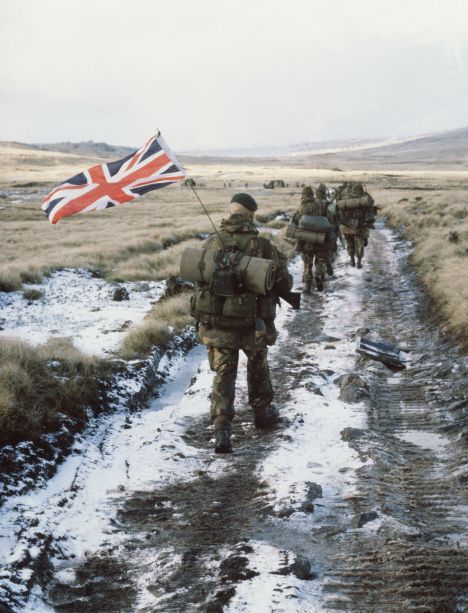 Royal Marines putting their boots to good use, due to a chronic lack of helicopters
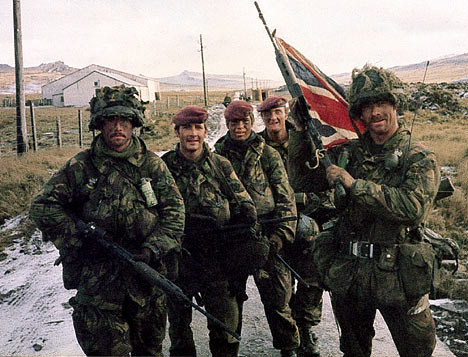 Paras pose for a victory snap after the battle of Goose Green
As good as it's looking, though, I can't help but feel a pang of disappointment. They finally got away from WWII... and caught up with every other dev, portraying modern warfare instead. While I must give them serious points for making the Generic Middle-Eastern Nation™ merely a sideshow rather than the chief bad guy, it's still just a modern war being fought with modern weapons by modern soldiers in various locations around the world. Don't get me wrong, I'll be all over MW2 when it goes up for pre-order, but I just feel let down that once again, a whole array of other conflicts have been passed over.
My pet hope is that one day, somebody will make a game set during the Falklands War. It was an exceptionally hard fight in an extremely inhospitable environment; elite British troops of the Royal Marines and the Paras were pitted against a vastly larger force of Argentine conscripts, as well as a small contingent of Argentine Special Forces. An Argentine Exocet hit and sank the Atlantic Conveyer, sending the bulk of the British force's transport to the bottom of the South Atlantic; the soldiers were forced to march over rock-strewn peat bogs and dense scrub, up steep mountains and through heavy fire by day and by night. As can be expected from the South Atlantic, the weather was absolutely vile at best, and as a result, losses on both sides were more or less equal (not counting the 300-odd Argentine sailors lost when HMS Conqueror torpedoed the General Belgrano). The terrain and the distances involved meant that both sides' soldiers had very little in the name of support. It would be hard to even imagine up a harder conflict.
So with that in mind, this is my challenge to any current or hopeful future developers who may be reading:
Give us something we haven't had hundreds of iterations of already. Give us something interesting. Give us something that many people either haven't heard of, or are at risk of forgetting.
Give us a Falklands title.
Royal Marines putting their boots to good use, due to a chronic lack of helicoptersParas pose for a victory snap after the battle of Goose Green...Please.
Subscribe to:
Comments (Atom)

 Posts
Posts

